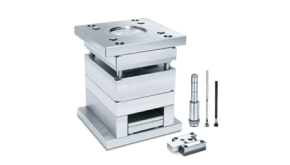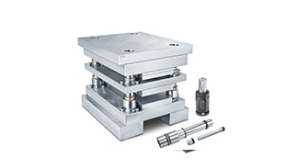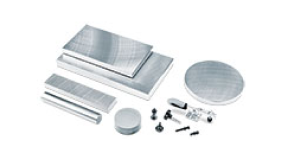


Overview guiding elements
We offer a wide range of high-precision guiding elements in many different designs available as bearing and sliding guide units.


Comparison of guiding types
Bearing guides
The bearing guides ensure maximum guiding speeds and high stability thanks to low rolling friction and preloaded bearing elements.
Sliding guides
Thanks to the large contact surface of sliding guide bushes, maximum shear forces can be transmitted.
Ball guides

Areas of application
- For highest speeds
- For maximum precision
- For high requirements regarding radial offset
- For thin sheets
Characteristics
+ Minimal wear through axial offset of the balls
+ Special inlet geometry guarantees a smooth entry of the balls
+ Free-of-play guiding through optimal preload
+ Smooth running through rolling motion of the balls
+ Allows easy closing action of the dies
– Can become overloaded at high shear forces due to the point contact
– Stroke/path is limited
Roller guides

Areas of application
- For high speeds
- For maximum precision
- For higher stiffness requirements than with the ball guide
- Suitable for fine blanking due to high shear forces
Characteristics
+ Minimal wear through axial offset of the rollers
+ Special inlet geometry guarantees a smooth entry of the rollers
+ Free-of-play guiding through optimal preload
+ High stiffness due to the line contact of the rollers
+ Far more resilient than the ball guide
– Stroke/path is limited
– More expensive than the ball guide
– Can only be used with axial movements
Bronze-coated sliding guide

Areas of application
- Ideal for limited speeds (30 m/min)
- For die clearances bigger than 0.03 mm due to the medium play of 0.01 mm (G4)
- Ideal for thick strips due to the high shear forces
Characteristics
+ The circumferential oil groove ensures perfect lubrication – also in case of short strokes
+ Stroke/path is not limited – extension of the pillar is possible
– Risk of die tilting during the closing action
Self-lubricating sliding guide

Areas of application
- For self-lubricating applications thanks to the oil depot and solid lubricant MoS2 in the sintered layer
- Up to 250 °C
Characteristics
+ The frictional heat causes the oil to rise to the sliding surface; through capillary action the oil retreats back into the sintered layer (when the machine is idle)
+ The ideal diffusion zone between the sintered layer and the steel sheath ensures inseparable molecular bonds
+ High resistance to abrasive wear and very good emergency operating features without additional lubrication
Sliding guide made of steel

Areas of application
- For high shear forces
- For short stroke rates
Characteristics
+ The circumferential oil groove ensures perfect lubrication – also in case of short strokes
+ Guiding diameter honed to Ra 0.3 for low coefficients of friction
– Possible die tilting during the closing action
Sliding guide made of solid bronze

Areas of application
- For large sheet thickness due to guide tolerance G6
- For moderate stroke rates
- For medium shear forces
Characteristics
+ Optimum lubrication through graphite rings
+ Reduced wear through initial lubrication with VGM 160
+ Stroke/path is not limited – extension of the pillar is possible
– Continuous abrasion of the solid lubricant