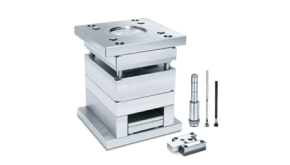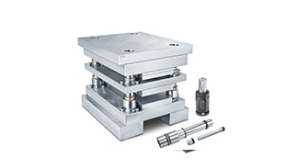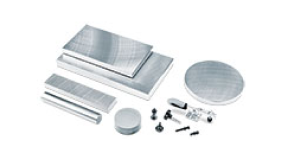


The world is becoming smaller, both logistically and economically. Globalisation increases the competitive pressure on mould and die makers, but also offers the chance to profit from orders in fast-growing markets. At the same time the innovation wheel is turning at an increasingly faster speed, which requires adaptability and flexibility from companies. The high cost and time pressure forces companies to constantly improve their efficiency. A high degree of standardisation along the entire process chain offers an excellent opportunity to drastically reduce costs and project lead times.
In the product life cycle of a die, it is important to take a holistic view of the costs. Right from the beginning of a project, possible savings should be considered. The use of standard parts has a positive effect on the overall costs. Helpful questions are for example: are there die components which can be standardised? If so, what possibilities are there to fall back on internally standardised parts or die concepts? Could these be bought from an external standard parts manufacturer? There are lots of potential savings to be made here, and thus clear competitive advantages can be gained.

The design phase is crucial
The costs of a die can be greatly influenced during the development phase, whereas during serial production at the end of the product life cycle they can barely be reduced. The designer decides on the positioning of the parts, the machining sequence in the die as well as the layout of the individual machining stations and the feed. In this phase, the production parameters with which the die will later work in the stamping workshop are set. Furthermore, the designer decides if the die set can be made from in-stock standard plates or if customised special plates must be used. The more standard parts used, the higher the percentage of fixed calculable costs.
Quickly to the goal with digital wizards
By using standard parts, savings can be made in all areas. This begins with a fast and reliable pre-calculation by means of the Meusburger wizards. With these tools, all necessary components for a project can be quickly and easily put together and saved for later. CAD data of complete die sets can be exported from the Meusburger portal with just a few clicks and imported to all common CAD systems. This gives the designer more time to concentrate on the actual ‘critical points’ of a die.
Success thanks to 40,000 items
Meusburger offers over 40,000 items in die making, which are specially tailored to customer requirements. The low-deformation material itself has a big influence on the manufacturing and maintenance costs of the dies: thanks to the high-grade steel, which is heat-treated for stress relief, and to the exact form and location tolerances, subsequent costs can be reduced. Important functions in the die are also performed by components such as active parts. Buying these from external suppliers, rather than producing them in-house, offers significant additional savings and therefore long-term competitive advantages. The best time for putting this into practice is quite simply now!
Tips & tricks for standardisation
- Create quality standards through low-deformation plates
- Develop design guidelines
- Reduce the variety of components used
- Use standardised components and lower manufacturing costs
- Create machining guidelines, such as predefined tolerances or dimensions
- Create standardised processes