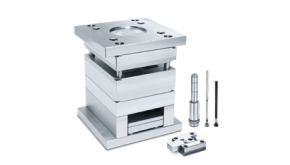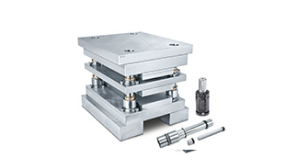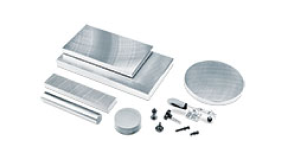


Round bars as key components for making moulds, dies, jigs and fixtures
Round bars are indispensable in many areas of manufacturing. They serve as a base material for high-precision components and provide a solid foundation for a wide range of applications.
Round bars are primarily used in applications where dimensional stability and dimensional accuracy are crucial. Typical applications include:
- Mould making: Here, round bars are processed into core pins, guide pins or cutting elements. They ensure the highest precision and durability of the moulds.
- Die making: Guide bushes, retainer clips, guide pillars and cutting punches can be made from round bars.
- Machine and jig construction: Round bars serve as the basis for shafts, axes, bolts or bushes used in machines or jigs and fixtures.
- General turning of round parts: From simple axes to complex precision parts – round bars enable the manufacturing of a wide variety of components for a diverse range of industrial applications.

Why choose round bars from Meusburger?
Our round bars are hot rolled or peeled and sawn to the desired dimensions. This guarantees consistent quality and high dimensional accuracy for every application.
Whether for core pin production, precision parts or general round part manufacturing – with our round bars, you can count on reliability and precision that will take your manufacturing to the next level.

Round bars in all varieties and grades of hardness


Which steel for which round part?
Mould inserts
| Inserts for working with chemically aggressive plastics; because of excellent polishability, suitable for optical and medical products | 1.2083 / 1.2083 ESR |
| Inserts and high-strength machine parts | 1.2311 |
| For processing corrosive plastics | 1.2316 |
| Mould inserts for plastic injection moulds; ESR for die casting applications (Al, Mg, Zn) | 1.2343 / 1.2343 ESR |
| Standard material for hot-work tools, extrusion dies, forging dies, moulds for plastic processing | 1.2344 |
| Inserts as well as cutting punches, punch backing plates and die plates with high requirements on wear resistance | 1.2379 |
| Mould inserts, cores and slides for plastic injection moulds | 1.2714 HH |
| Demanding cavity plates and mould inserts with high surface requirements (mirror polishing); stamping, forming and bending inserts for particularly high compressive and bending strength | 1.2767 |
| Mould inserts exposed to abrasive stress; cutting punches; punch backing plates, die plates and guiding plates; guiding rails | 1.2842 |
| Blocks for eroding, cold forming tools such as cutting or fine blanking punches, impact extrusion punches, and die plates; mould inserts with very high wear resistance | 1.3343 |
| Guide elements, cores and mechanical parts with high surface hardness; synthetic resin press moulds for processing thermoplastics and thermosetting plastics | 1.7131 |
Cutting punches
| Small turned parts, core pins, punches and engraving tools | 1.2210 |
| Inserts as well as cutting punches, punch backing plates and die plates with high requirements on wear resistance | 1.2379 |
| Demanding cavity plates and mould inserts with high surface requirements (mirror polishing); stamping, forming and bending inserts for particularly high compressive and bending strength | 1.2767 |
| Mould inserts exposed to abrasive stress; cutting punches; punch backing plates, die plates and guiding plates; guiding rails | 1.2842 |
| Blocks for eroding, cold forming tools such as cutting or fine blanking punches, impact extrusion punches, and die plates; mould inserts with very high wear resistance | 1.3343 |
Machine & jig construction
| Unhardened parts for mould, die, and jig construction | 1.1730 |
| Corrosion-resistant parts for mould, die, and jig construction | 1.2085 |
| Inserts and high-strength machine parts | 1.2311 |
| High-strength machine parts | 1.2312 |
| For processing corrosive plastics | 1.2316 |
| Guide elements, cores and mechanical parts with high surface hardness; synthetic resin press moulds for processing thermoplastics and thermosetting plastics | 1.7131 |
| Rotary tables, machined parts for machine and jig construction, moulds for prototypes and foamed parts | 3.3547 |
| Plates for mould bases and die sets with increased requirements on strength; parts for machine and jig construction | 3.4365 |

Material numbers for steel explained simply
Choosing the right material is a key factor for success in mould and die making – yet behind these seemingly cryptic material numbers lies a clear system. In this blog post, we show how material numbers are structured, what their digits mean, and why they are so important in practice.