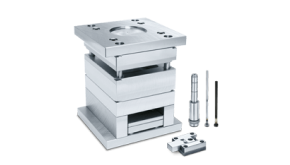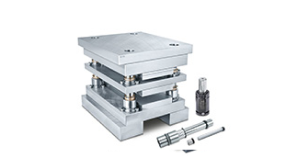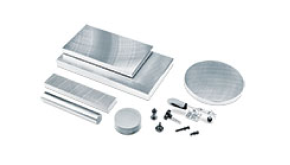


The cavity pressure is an important parameter in process monitoring in injection moulding. Pressure sensors are therefore indispensable for comprehensive mould monitoring: the use of high-quality sensors leads to optimal process quality and sustainably increases part quality.
The range includes types for direct and indirect measurement as well as suitable mounting accessories and connection technology – as usual available from stock with simple CAD data download, including installation spaces.

Functional principle and uses of cavity pressure sensors
Cavity pressure sensors enable the conversion of the pressure in the cavity to a measurable charge by means of the piezoelectric effect. The sensors are equipped with high-precision quartz crystals (SiO2 or α-quartz), which release a charge under the influence of pressure or force. This charge, amplified by a charge amplifier, provides precise information about the pressure applied to the sensor, thereby enabling exact cavity pressure monitoring in the injection moulding process.
The ideal installation position in the mould depends on the application. Typical applications are strength monitoring and monitoring or controlling viscosity, compression or shrinkage.


Direct and indirect cavity pressure sensors
Depending on the application, there are two types of pressure sensors: direct and indirect sensors, which are used for direct or indirect pressure measurement.
Direct measurement

For direct measurement, the pressure sensor is inserted directly into the cavity, so the cavity pressure can be measured directly in the respective area. When pressure is applied, the sensor delivers an electric charge (pC), which is then converted into a change of pressure (bar) through the specified sensor sensitivity (pC/bar).
Indirect measurement

The indirect measurement of the cavity pressure is carried out via a force sensor, which is located outside the cavity and is indirectly actuated by a force. Unlike with direct sensors, the cavity pressure is transmitted to the sensor as a force via an ejector pin. In response to this force, the sensor emits an electric charge (pC), which is then converted into a change of force (N) through the specified sensor sensitivity (pC/N). This change of force combined with the front surface of the ejector is used to calculate the pressure change.
Cable technology
Two different technologies are available on the market for charge transfer: the sensors can be connected via single-wire cables, with electrical shielding provided by the injection mould, or via coaxial cables, which are themselves electrically shielded.
Single-wire

The single-wire cable has a very small cable diameter, so it can be routed flexibly with minimal bending radii in cable slots and holes, and shortened as required. Single-wire cabling is the ideal solution for moulds with limited space and offers compact and efficient connection options that are also cost-effective.
Coaxial

The coaxial cable is characterised by optimum shielding against external signals thanks to its steel sheath. The use of cavity pressure sensors with a coaxial cable is therefore ideally suited for moulds with a high number of electrical components, such as hot runner components or monitoring equipment. This variant is also used if the cables are not completely surrounded by the steel of the mould.
Signal transmission options
There are two different options for signal transmission: transmission of a single sensor signal or transmission of multiple sensor signals.
Transmission of a single sensor signal

This type of signal transmission is used for moulds where only one sensor is installed or an individual connection of each sensor to the charge amplifier is required. The single-wire sensor cable with single-channel connector E 6762 enables a simple connection of the cable via a practical insulation displacement contact. The coaxial sensor cable E 6756 is pre-assembled and offers a plug & play solution for quick and reliable installation.
Transmission of multiple sensor signals

Multi-channel connectors enable the simple and efficient merging of up to 8 cavity pressure sensors, which minimises the amount of cables required. Depending on the version, the multi-channel connectors have insulation displacement contacts for the single-wire cable or mini coaxial female connectors for the mini coaxial cable. These practical connectors are an elegant solution for clean, space-saving installation.